The Forest Canopy's Greatest Secret
For centuries, archaeologists believed the Amazon rainforest was too harsh to support large, complex civilizations. That assumption has been shattered by laser pulses fired from aircraft above Bolivia's Llanos de Moxos, revealing one of the most sophisticated urban networks in pre-Columbian America.
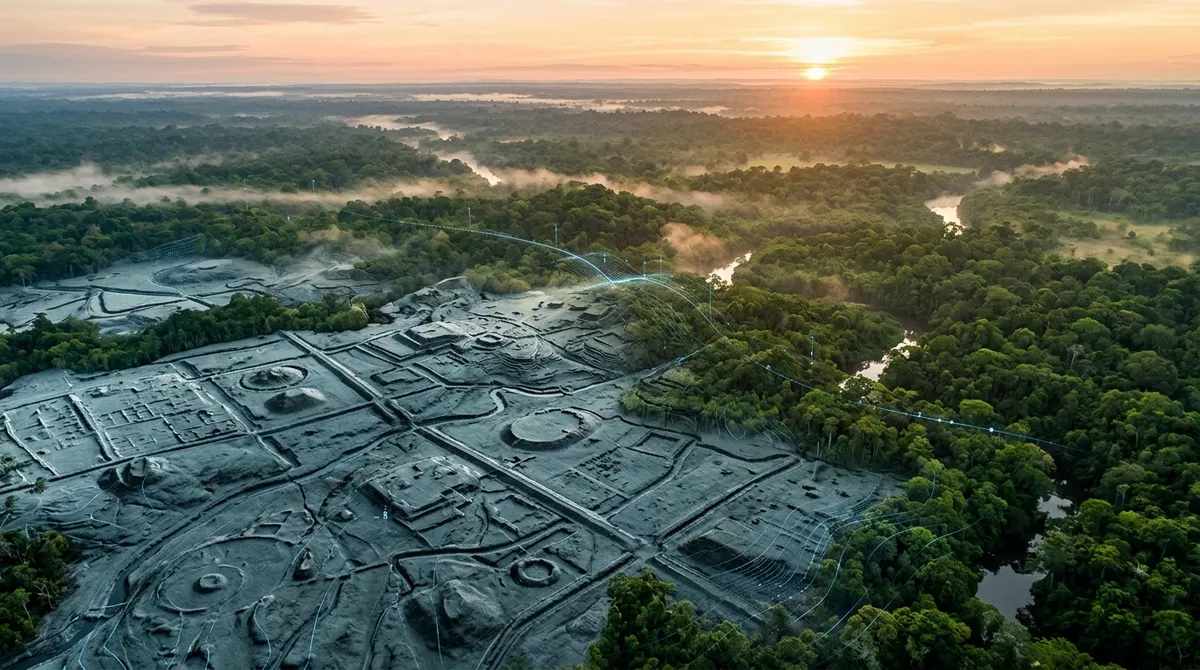
Lidar technology—which uses laser pulses to penetrate forest canopy and reveal terrain beneath vegetation—has uncovered the remains of the Casarabe culture, a civilization that dominated 20,000 square kilometers of northern Bolivia from AD 500 to 1400. What researchers found challenges everything we thought we knew about Amazonian societies.
A Four-Tier Civilization Hidden in Plain Sight
The Casarabe weren't building small villages scattered randomly through the forest. According to reports from the discovery, they constructed a sophisticated four-tier settlement hierarchy that would have impressed urban planners anywhere in the ancient world.
At the top were primary settlements spanning up to 3 square kilometers—larger than many medieval European cities. Below these were secondary and tertiary sites, all connected by an intricate network of raised causeways and canals. The fourth tier consisted of isolated mounds dotting the pampas, likely serving specialized functions in this vast urban network.
The scale of their monumental architecture rivals anything found in the Andes. The Casarabe built 20-meter conical pyramids and U-shaped public gathering structures, along with man-made platforms rising 5 meters and extending over 20 hectares. These weren't crude earthworks—they were engineered landscapes that demonstrated sophisticated understanding of hydrology, astronomy, and urban planning.
Engineering Water in the Tropics
Perhaps most remarkably, the entire civilization was organized around engineered water systems. The Casarabe developed a drained-field agriculture system with maize as the primary crop, supported by diverse secondary crops. They built water-management systems including reservoirs and farm ponds to ensure sustainability during dry seasons.
This wasn't accidental—raised causeways and canals connected forest islands across the landscape in a carefully planned network. The engineering required to maintain such a system across 20,000 square kilometers, in one of the world's most challenging tropical environments, speaks to a level of organizational sophistication that archaeologists are only beginning to understand.
Cosmology Meets Infrastructure
The Casarabe didn't just build functionally—they built spiritually. According to the discovery, major architectural features and burial sites show a consistent north-northwest orientation, suggesting cosmological influence on their urban planning. This civilization integrated their understanding of celestial bodies into the very layout of their cities, creating landscapes that served both practical and spiritual purposes.
This orientation pattern appears throughout their territory, indicating a shared cosmological framework that guided construction across hundreds of settlements over nearly a millennium.
Low-Density Urbanism: A Different Way to Build Cities
What makes the Casarabe particularly fascinating to modern urban planners is their model of low-density tropical urbanism. Unlike compact Andean cities like Tiwanaku, the Casarabe spread their urban functions across vast areas, creating what researchers compare to other low-density tropical urban landscapes found among the Maya and at Angkor.
This approach allowed them to thrive in a tropical environment where concentrated populations might have struggled with disease, resource management, and environmental challenges. They created Amazonian Dark Earths—engineered soils combining charcoal, bone, and waste with native soil—that enriched the landscape for agriculture while maintaining ecological balance.
Rewriting Amazonian History
This discovery represents a fundamental shift in archaeological understanding. Evidence shows that plant domestication in Amazonia has been occurring since the end of the Ice Age, and Amazonian peoples were among the earliest ceramic manufacturers in the Americas. The 20th century brought a major shift in archaeological understanding of the Amazon's capacity for large settlements, but the Casarabe discovery pushes that understanding to new levels.
The revelation challenges persistent colonial-era myths about the Amazon being "untamed wilderness." Indigenous peoples never forgot these landscapes—only outsiders dismissed their significance. The sophisticated land management demonstrated by the Casarabe offers lessons for sustainable development as climate change and deforestation intensify focus on the region's ecological and cultural significance.
Technology Reveals What History Forgot
Lidar technology is proving to be archaeology's game-changer, revealing hidden ancient worlds beneath forest canopies across the globe. In the Amazon, it's not just finding lost cities—it's uncovering a completely different model of how humans can build sustainable civilizations in challenging environments.
The Casarabe culture thrived for nearly a millennium in one of the world's most complex ecosystems, leaving behind a blueprint for low-impact urbanism that modern city planners are only beginning to appreciate.