Mongolia is one of the few places on earth where your kids can ride a horse across open steppe, sleep in a nomadic family's ger, and watch an eagle hunter demonstrate a tradition that stretches back centuries — all in the same week. By the end of this guide, you'll understand what actually makes a Mongolia family trip work: the logistics that trip people up, the experiences worth building your itinerary around, and the realistic prep that turns a daunting destination into a manageable adventure.
Why Mongolia Works Better for Families Than You'd Expect
The instinct is to file Mongolia under "someday, when the kids are older." That instinct is wrong, and it usually comes from confusing remote with difficult. Yes, Mongolia sits well outside the comfortable infrastructure of Western Europe or Southeast Asia's tourist trail. But remoteness here is precisely the point — and it works in families' favor.
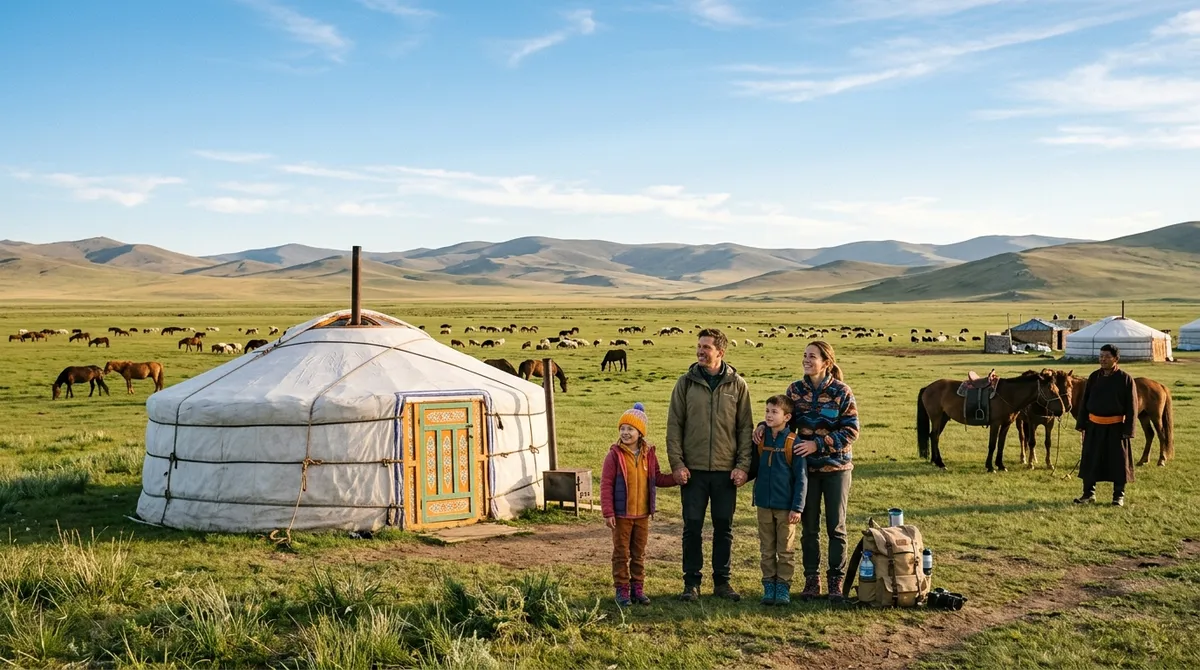
The landscapes are enormous and forgiving. There's almost no traffic. The cultural interactions are genuine rather than staged. And Mongolian nomadic culture centers on family life, which means children are welcomed, not just tolerated, at every ger you visit. Nomadic families will hand your five-year-old a lamb and think nothing of it.
The honest tradeoffs: roads outside Ulaanbaatar range from rough to nonexistent, medical facilities in rural areas are limited, and the food is meat-heavy. None of these are dealbreakers, but they require honest planning.
The Logistics That Actually Matter
Getting There and Around
Ulaanbaatar is the entry point for almost all international visitors and is served by flights from major Asian hubs. From the capital, most families move around the country by a combination of domestic flights (for longer distances) and chartered 4x4 vehicles or Russian furgons — boxy, all-terrain vans that handle off-road conditions better than they look like they should.
For families, a private vehicle with a driver-guide is worth every extra dollar. You set the pace, stop when a child needs to, and aren't locked into a group tour schedule. Book this through your tour operator before you arrive; don't try to arrange it on the ground.
Where to Sleep
Ger camps are the standard accommodation outside Ulaanbaatar, and for families they're genuinely excellent. The circular felt tents are warm, the beds are real, and the shared communal meals in a central dining ger give kids a social structure they find comfortable. Tourist-grade ger camps include western toilets and hot showers. True nomadic homestays skip those amenities but offer far more authentic cultural exchange — something to weigh based on your children's ages and adaptability.
Ulaanbaatar has reliable international-standard hotels for your arrival and departure nights. Use them to decompress.
Health and Safety Prep
Consult a travel medicine clinic at least six weeks before departure. Mongolia sits at high altitude in parts, has limited rural healthcare, and requires consideration of vaccines that aren't part of standard schedules. Pack a thorough first aid kit, oral rehydration salts, and any prescription medications in sufficient quantity. Travel insurance with medical evacuation coverage is non-negotiable for a trip this remote.
Experiences Worth Building Your Itinerary Around
The Gobi Desert
The Gobi is the anchor experience for most families, and rightfully so. The Khongoryn Els sand dunes — some reaching 300 meters — are the kind of landscape that resets a child's sense of scale. Camel trekking across the dunes is manageable for most kids over five, and the surrounding area offers dinosaur fossil sites that will send any prehistory-obsessed child into genuine rapture. The Flaming Cliffs, where American paleontologist Roy Chapman Andrews discovered the first known dinosaur eggs in the 1920s, are accessible and visually dramatic.
Central Mongolia's Steppe and Khövsgöl Lake
The central steppe around Kharkhorin — site of the ancient Mongol Empire capital Karakorum — gives families a strong historical anchor. The Erdene Zuu monastery complex, built partially from the ruins of the old capital, is walkable and photogenic. Children who engage with the Genghis Khan narrative (vast, horseback, empire-building) find the site clicks immediately into something they understand.
Khövsgöl Lake in the north is Mongolia's version of a mountain lake district: clean water, pine forests, and the territory of the Tsaatan reindeer herders. If your itinerary allows a northern extension, this is the leg most families remember longest.
Eagle Hunting Demonstrations
In western Mongolia, Kazakh eagle hunters still practice the ancient tradition of training golden eagles for hunting. Visiting a hunting family and watching a demonstration is one of those rare travel experiences that doesn't feel performed — the relationship between hunter and bird is real, practiced daily, and extraordinary to witness. The region is a longer journey from the Gobi, so build this in only if you have ten days or more.
A Realistic Family Itinerary Shape
For a first trip, ten to fourteen days is the right length. A practical framework:
Days 1–2: Ulaanbaatar. Visit the National Museum of Mongolia for historical context before heading into the countryside. Gandan Monastery gives kids an active, sensory introduction to Tibetan Buddhism.
Days 3–5: Central steppe. Karakorum ruins, Erdene Zuu monastery, horseback riding on the open steppe.
Days 6–9: Gobi Desert. Khongoryn Els dunes, camel trekking, Flaming Cliffs fossil sites, overnight in a Gobi ger camp.
Days 10–11: Return to Ulaanbaatar with buffer time for delays — and Mongolian roads will create delays.
A fourteen-day trip can add Khövsgöl Lake via domestic flight, which most families who've made the effort consider worth it.
How to Prepare Your Kids (and Yourself)
The single most useful thing you can do before leaving is set honest expectations with your children about discomfort. Bumpy roads are long. Meals will be unfamiliar. Some days the "plan" will dissolve entirely. Frame this explicitly as part of the adventure rather than trying to shield them from it.
For younger children, give them one job during the trip — tracking animals spotted, photographing details, keeping a simple journal. Purpose prevents boredom on long drives more reliably than screens.
For parents: find a tour operator with specific Mongolia family experience rather than a generalist. The difference in logistics and itinerary calibration is significant. Margot Kong of Journeys Unparallelled, who recently returned from Mongolia with her own family and whose experiences informed Travelweekly's reporting on this destination, is one operator with that specific background.
The Honest Case for Going
Mongolia asks something of the families who visit it. The roads are rough, the distances are real, and the infrastructure won't smooth over every difficulty. What it gives back is a landscape and a culture that most children will not encounter anywhere else — and the particular confidence that comes from a trip that required something and delivered more. Plan carefully, leave room for the unexpected, and go.