TL;DR
Lidar technology has revealed a major urban complex built by the ancient Casarabe culture in the Amazon, challenging previous ideas about pre-Columbian civilizations in the region. This discovery highlights sophisticated settlement planning, agricultural practices, and unique engineering methods that offer modern sustainability lessons.
A New Lens on the Ancient Amazon
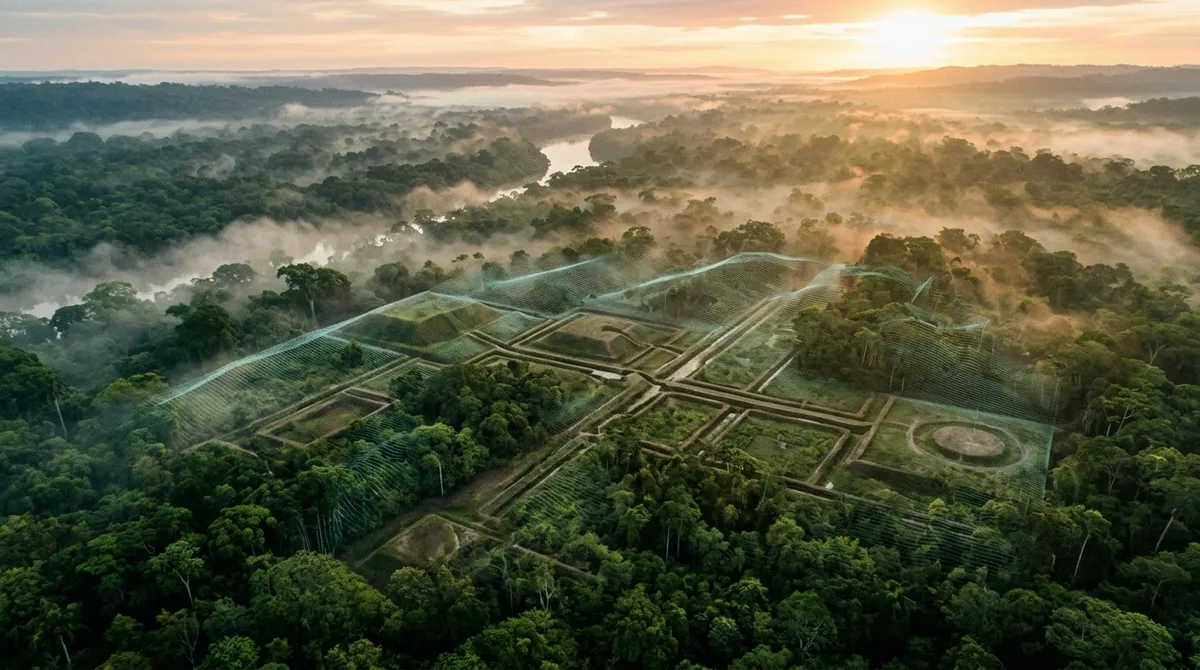
For centuries, the Amazon rainforest has been painted as a barren wilderness, an untouched landscape teeming with nature but lacking human history. This narrative is being dramatically rewritten, all thanks to a groundbreaking technology known as Lidar (Light Detection and Ranging). Imagine peering through the dense canopy of trees typical of the Amazon, only to uncover an elaborate city sprawling beneath. This is exactly what Lidar has unveiled in Bolivia's Llanos de Moxos—the sophisticated world of the Casarabe culture.
Lidar: The Game-Changer in Archaeology
Lidar uses laser pulses to penetrate forests and other dense landscapes, mapping the terrain below with incredible precision. This tool has unlocked layers of history previously unseen—revealing the extensive urbanism of pre-Columbian civilizations. Rather than a scene dominated by scattered villages, we find evidence of a vast, interconnected urban landscape covering over 20,000 square kilometers.
The Casarabe Culture: A Flourishing Society
Flourishing between AD 500 and 1400, the Casarabe culture established a multi-tiered settlement hierarchy comprising primary sites of up to three square kilometers, alongside secondary and tertiary areas, and even isolated mounds dotting the landscape. The result? An intricate network living harmoniously within their environment—an artistic dance of nature and civilization.
Monumental Architecture Meets Cosmology
The architectural feats of the Casarabe are nothing short of breathtaking. Think towering conical pyramids, civic-ceremonial structures, and expansive platforms—some even rising to 5 meters high and sprawling over 20 hectares. These constructions were not simply utilitarian. They were intentionally oriented towards celestial bodies, suggesting that cosmological beliefs deeply influenced their engineering and urban planning.
Structures That Tell a Story
Among the highlights are 20-meter-tall conical pyramids and U-shaped gathering areas that catered to larger community gatherings and rituals. Those who explore these ancient structures are not merely observing relics of the past; they are engaging with the very essence of Casarabe culture.
Advanced Water Management and Agriculture
The environmental challenges posed by the Amazon rainforest also led to innovative solutions. The Casarabe integrated sophisticated water management systems, which included reservoirs and farm ponds essential for maintaining agricultural productivity during the dry season. Their agricultural practices were equally forward-thinking, cultivating maize and diverse secondary crops through advanced drained-field systems.
Engineered Earth
The inhabitants of this land also embraced the creation of Amazonian Dark Earths—soils engineered from charcoal, bone, and other organic waste, enriching what was previously deemed inhospitable land.
Decolonizing the Amazon Narrative
The revelations brought forth by Lidar are pivotal in a broader discussion about the Amazon's narrative in history. For years, Western perspectives have belittled indigenous cultures, painting them as primitive. The sophisticated urban planning and environmental management of the Casarabe culture not only defy such stereotypes but also urge us to reconsider the Eurocentric narratives that have dominated archaeology.
Lessons for Modern Sustainability
As climate change looms and the effects of deforestation intensify, these ancient practices emerge as beacons of wisdom for modern sustainability efforts. The Casarabe lived resiliently in a challenging environment for nearly a millennium—surely, we could stand to learn a thing or two from their methodologies.
A Narrative Rediscovered
The Casarabe may not fit neatly into the story of large, compact Andean cities like Tiwanaku, but their legacy teaches us that urbanism comes in many forms. As we learn about the Amazon and its complex histories, we begin to acknowledge the diverse, rich cultures that have thrived long before recorded history.
The cities were never truly lost; they exist within the memories of indigenous peoples. It is time we, as global citizens, honor and recognize these narratives as integral to understanding our world today.
Conclusion
With each laser pulse, Lidar is not only unearthing ancient cities but also rewriting the human story of the Amazon. From advanced engineering to sustainability practices, the ancient Casarabe culture provides invaluable lessons for confronting today’s ecological challenges, encouraging a future where humanity and nature coexist harmoniously.